Penrith have found their steel while Brisbane have lost their nerve
Penrith’s defence delivered the real warning
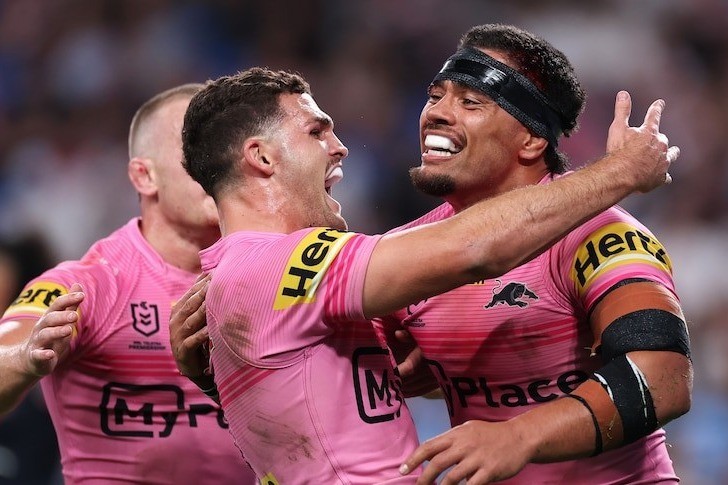
Penrith’s victory over Melbourne was not merely another win; it was a reminder that their premiership steel remains intact, even during a sin-bin-a-thon that reduced the contest to something resembling rugby league conducted through revolving doors.
The Panthers spent long periods protecting their lead without a full complement, including time with 11 men, while Melbourne had substantial second-half possession and repeated six-again opportunities. Melbourne are not as elite as they have been across the past couple of grand finals, but Cameron Munster, Harry Grant and Siua Faletau still provide enough attacking dynamite to punish any side that blinks. Penrith refused.
Brian To'o supplied the theatre with a phenomenal circus-style put-down and moved to 102 tries, which I think leaves him second on Penrith’s all-time list and chasing Reece Wesser’s 113. More importantly, I don’t reckon there is a better winger in the competition coming out of yardage.
The Roosters remain in the box seat for first place, with Penrith and the Warriors likely to fill the next two positions. Those are the three genuine heavyweights. The Dolphins are improving, but I reckon their real window opens next year.
The bunker got Liam Martin badly wrong
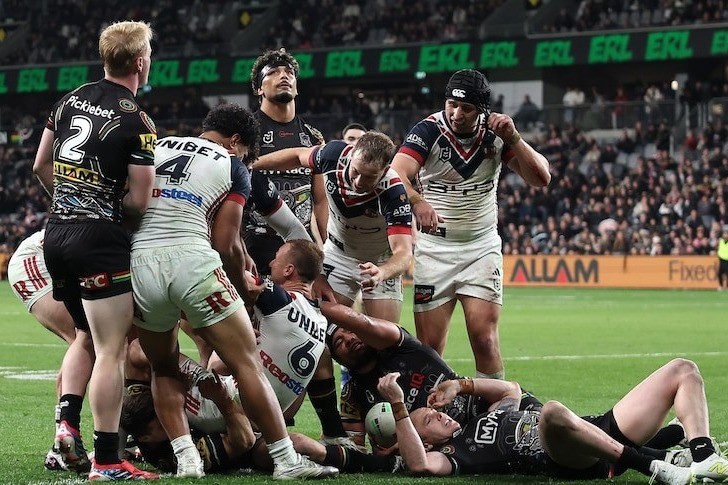
Liam Martin’s sin bin was indefensible, and the inconsistency surrounding it should concern every club heading towards the finals. Martin did not step across to close the gap; he planted himself, stopped and could not disappear, yet the bunker turned an unavoidable collision into 10 minutes on the sideline at a crucial stage.
I could cop Oryn Keeley and Lindsay Smith being binned after fourth infringements and repeated warnings from Grant Atkins, while Jack Cogger’s forceful head contact also justified action. Martin’s incident belonged in a different postcode. The absurdity arrived in the second half when the same type of obstruction produced only a penalty, no try and no professional foul.
NRL headquarters now reviews games with a fine-tooth comb and officials study club tendencies through tip sheets, which is sensible preparation, but analysis becomes counterproductive when it manufactures offences that are not there. Adam Gee has shown how a major contest can breathe when the referee understands his role. Finals should be decided by players, not by a bunker searching for a technicality with tweezers.
Hard workers still hold premiership packs together
Ray Stone’s retirement at 29, after 108 first-grade games, is a reminder that rugby league still extracts its highest price from the blokes who receive the least fanfare. Stone was never sold as an X-factor player. He was the player who made X-factor possible — competing on every play, cleaning up the mess and wringing every last drop from his body.
Are those players undervalued? Absolutely. Recruitment meetings can become hypnotised by speed, skill and highlight reels, but a premiership pack needs three or four tradesmen prepared to carry the ugly workload. Without them, the stars spend too much petrol doing jobs they were never selected to do.
The balance is particularly important on the edges. A back-rower cannot simply hold his lane and wait for the big play. He must take carries that spare the middle, fold into the hard defensive work and keep moving when the set has lost its shape. That support gives the front-rowers a set to recover, then allows them to return with enough in the tank to bend the line rather than merely survive it.
That is why I value players such as Max Plath, Victor Radley, Liam Martin and Hudson Young. Different bodies, different skill sets, same appetite: they punch out big minutes, never stop three steps short and do not need the ball to influence a game. Glenn Stewart built a career on the same principle. The work was relentless, but never mindless.
The salary cap tempts clubs to shop for polish. The smart ones first buy the engine room, then find the chrome. Premiership packs are not held together by glamour. They are held together by the bloke willing to make the next carry when everyone else is looking at his boots.
Papalii deserves a farewell with fire in it
Josh Papalii’s Canberra farewell should be treated as an occasion, not another fixture squeezed into the calendar. His 341st NRL game comes after a career spent largely in the middle, where longevity is measured less in birthdays than in collisions survived, and his 50 representative appearances push his senior tally towards 400.
Dave Furner will sound the Viking horn before Canberra run out, and Ricky Stuart will have the Raiders breathing fire because good coaches make milestone matches about the individual who earned them. Simi Sasagi is playing his final game of the year despite a bad shoulder because he wants to be there for Papalii. That tells you what the big prop means inside the building.
Papalii began on an edge, had footwork off both feet and refused to retreat from confrontations even as a young player. He also once signed a three-year Parramatta deal before Canberra persuaded him to backflip under the old round-13 rule, reportedly prompting a furious Stuart to launch a golf club. Some careers are built on careful planning. The memorable ones usually contain a flying iron.
International allegiance cannot become a revolving door
Payne Haas should not be allowed to bounce between international nations whenever circumstances change. I heard he was seriously considering redeclaring for Australia after only recently switching, but hand surgery will now rule him out of all international football at the end of the year.
Representing a Pacific nation to strengthen it is admirable; treating that commitment like a club contract with an escape clause is not. Choose the jersey, understand what it means and stay with it.
The payment structure, however, is indefensible. The Sydney Morning Herald reported that Kangaroos players receive a flat $40,000 while players from opposing nations receive $850 per game. If those figures remain the arrangement, they make a mockery of claims about an international game built on equal respect. Players representing Tonga, Samoa and other Pacific nations have already sacrificed money to make those teams stronger. Administrators cannot applaud that sacrifice while preserving a financial chasm wide enough to drive a team bus through.
Kevvie’s move exposes Brisbane’s political failure
Kevvie Walters deserves his opportunity with St. Helens because his Brisbane exit was engineered before the club’s anonymous review had finished pretending to matter. The decision had already been made, Michael Maguire was coming in and the survey merely gave the executioners some stationery.
Walters will complete the World Cup before leaving despite previously being signed with the Kangaroos through 2028, and I understand why he wants the Super League challenge. His previous tenure did not finish on his terms; this job gives him time to put his own stamp on a club and prove he can succeed without Brisbane’s factions circling behind him.
The great fraud now is Brisbane promising another enormous root-and-branch review. The decision-makers already know they are keeping Maguire, while the same powerbrokers who removed Walters remain in control and under pressure. They committed fully to their chosen coach and must now own the consequences rather than manufacture another process.
A coach needs tactical intelligence, but he also needs allies in the media, corporate world and boardroom because rugby league politics is a nasty business. Walters learned that lesson through an ambush. St. Helens gives him the chance to answer it with football.
PNG’s tax advantage risks distorting the whole market
The Papua New Guinea Chiefs cannot be handed an unlimited recruitment weapon simply because the project needs help attracting players. Both governments have passed legislation making Chiefs players tax-free, and my mail is that the supposed requirement to spend 180 days in Papua New Guinea does not apply; as long as they are playing for the Chiefs, the concession stands.
That is wonderful for players and lucrative for the NRL, but it risks forcing every existing club to pay a premium merely to keep its roster together. Only 30 players can join the Chiefs, yet every negotiation will feel the pull of tax-free money. A limit on marquee recruits would have been a sensible safeguard.
AJ Brimson is the immediate test. The Titans have allowed him to speak with rivals after previously refusing his request, he is on a reported $900,000 until the end of 2030, and PNG is circling alongside interest elsewhere. I have no mail on his destination, but reading the tea leaves, Canterbury looks tailor-made because Brimson offers passing, running, speed, deception and a short kicking game.
Connor Tracey is a terrific utility, but Brimson has more levels as a fullback. If Canterbury land him, they take another significant step towards a premiership — and the Chiefs discover that free money does not automatically win every argument.