Latrell’s brilliance no longer excuses South Sydney’s brutal cap problem
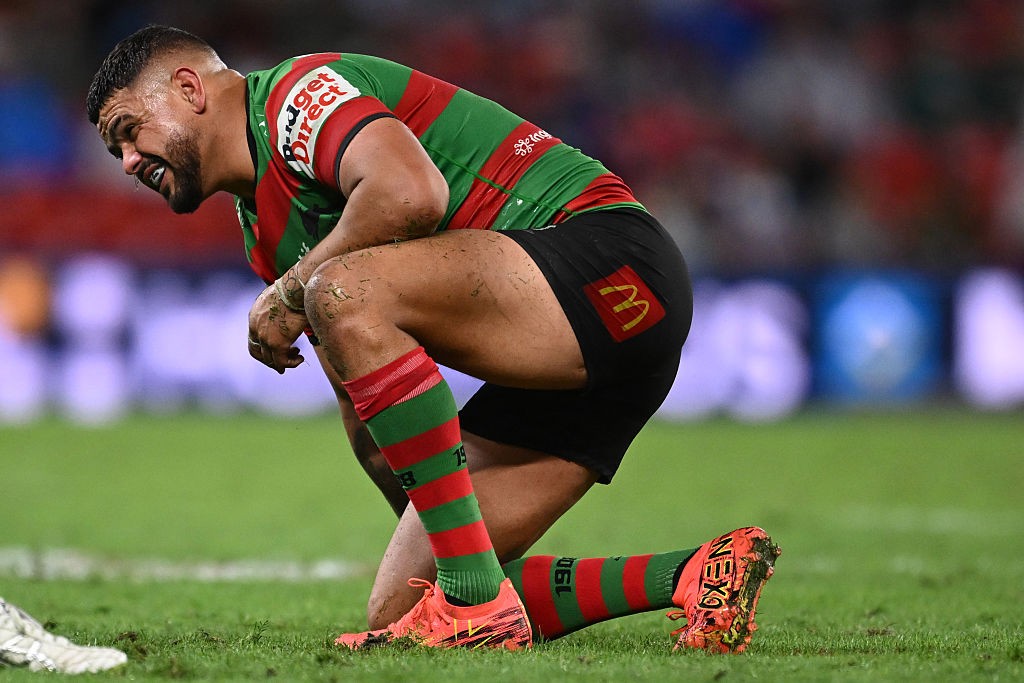
Latrell’s availability is now the problem
Latrell Mitchell is an elite game-breaker, but South Sydney cannot keep building a premiership campaign around a player who has appeared in only 95 of 166 games for the club. He has missed 71. That is not bad luck around the edges. That is a salary-cap problem sitting in the middle of the room.
His season may be over, he must see a neurologist and there is some suggestion of a nerve problem after the calf issue became linked to his back. South Sydney are still trying to identify the exact cause and, from talking to people around the club, the picture remains frustratingly vague.
I think the Rabbitohs’ season is effectively over without him. He could be their finals X factor, certainly, but first they must qualify and then trust a player who misses 40 per cent of their games to be available. They cannot bank on that. A reduced contract would invite rivals to move, but South Sydney must still confront the question: can this money be spent more reliably?
Bennett’s reputation cannot solve the injury crisis
Wayne Bennett should face pressure if South Sydney miss the finals again. Not hysterical pressure. Not a panicked execution. But real scrutiny, because recurring soft-tissue injuries believed to have started through training cannot simply be dumped in the bad-luck bucket.
South Sydney have changed their strength and conditioning staff and wondered whether Heffron Park is contributing, with the surface possibly offering too much or too little give. I do not know the cause, and I think the club is still searching for it, but injuries across numerous players suggest something is wrong.
Bennett is 76 and no longer entrenched at one club as he once was. Sam Burgess is said to be the next man for the job, although plenty must happen before South Sydney reach that decision. They will be stronger next year, with Payne Haas coming in, Ashton Ward improving and Cameron Murray remaining a machine. That makes fixing the physical preparation non-negotiable.
Injuries demand patience — and smarter recruitment
Clubs carrying savage injury lists deserve some forgiveness, which is why I think the heat on Michael Maguire is largely fan pressure. The Broncos have had the most injuries, while Penrith have used something like 24 players and sit near the bottom. Rip combinations apart every week and timing disappears.
Ben Darwin’s Gain Line work identifies cohesion and games played together as major indicators of success. That tracks. A replacement half or centre arriving one step late watches the gap close; a settled player recognises the same hole through repetition and punches through it.
Recruitment departments probably still do not weight availability heavily enough when allocating cap money. Tom Trbojevic recognised he was not playing every week and took a modest cut during his next contract cycle, freeing money to retain and recruit better players. That is what being a club man looks like. Talent matters. Availability multiplies it.
The NRL got both suspensions right
Latu Fainu deserved his three-week suspension. The tackle was low, but he did not use his arms, voluntarily dropped to one knee and had already received two concerning-act notices for similar tackles. I believe that pattern strips away the accident defence.
Leo Thompson landed on his head after being flipped. Rugby union has already moved against this style because of its danger, and rugby league once removed spear tackles and the Cumberland throw for the same basic reason: an unusual, rapid action can leave the ball-carrier unable to protect himself. Wait for the catastrophic concussion or neck injury and the game has waited too long.
David Fifita’s two-game suspension was also correct. His upward kick contacted Hudson Young’s head and I cannot justify it as anything other than an attempted strike. Leave it unpunished and the next player has a precedent to hide behind. The NRL cut out both acts immediately. Good. When it gets something right, it deserves to hear it.
Luai’s Pepsi proposal fails the smell test
Jarome Luai’s proposed Pepsi work is not merely a question of letting a player earn money. It is a glaring commercial conflict if he is playing for Parramatta, whose Powerade sponsorship sits under Coca-Cola, while promoting Pepsi in Papua New Guinea.
Luai has not signed the Pepsi deal yet, and I’m led to believe the proposal is worth about $3 million across three years. Until he proceeds there is no conflict, but if he signs it Parramatta will have a representative-calibre player promoting its sponsor’s direct rival. Pepsi could push that material through Australia and use it against Coca-Cola, while Parramatta would still insist Luai appear with Powerade during club duties.
Clubs fight hard for sponsors and then have to service them. They cannot collect the cheque while allowing their players to commercially kneecap the company paying it. Parramatta may technically be able to stop the arrangement, but managers and lawyers must sort that out. I think plenty more is coming because the conflict is too obvious to ignore.
The PNG tax story needed correcting
The Papua New Guinea money is not entirely tax-free in the way it was initially represented. A player’s salary is tax-free there and can be transferred to Australia with that treatment intact, but third-party income becomes subject to Australian law when it is moved here, including to purchase a house.
Hello Sport misunderstood the original third-party comments and treated everything as tax-free, but it owned the mistake. Fair play. I have made mistakes, misunderstood information and been lied to in good faith; I also got the New Zealand salary-cap issue wrong. Journalism delivers the best available truth that day, then corrects the record when better information arrives. Pretending otherwise is vanity.
Moses beat the interrogation fair and square
Mitchell Moses was not rude. The reporters kept dressing up the same question about next year, and he kept giving them the same answer because he wanted to concentrate on this season. He was too smart for them. The media needs to toughen up instead of complaining when a player refuses to walk into the trap.
I admit a bias towards Moses. When a mate’s daughter, aged 11 or 12, wanted her favourite player to sign a jersey, Moses offered to drive to my house and did exactly that. He did not need to. It revealed his values and his quality as a bloke.
Reporters can ask whatever they like. Players can answer however they like. Peter Bedell called Moses rude. I disagree. Moses held his ground, and the interrogation failed.