Nobby Clarke bluffed, battled & drank his way through a remarkable rugby league life
Football was already in the blood
Clarke never had to discover rugby league because it was waiting for him at home. His maternal grandfather was a Blinkhorn, his father played President’s Cup for Newtown and three Clarke brothers reached first grade, although Nobby insists he was never the sort of kid who raced home to study every match.
He played from under-sevens, represented New South Wales under-18s and thinks his first Balmain contract was worth $1,000, yet he didn’t regularly attend matches at Leichhardt and even supported the Bulldogs because Bernie Launder — the flying intercept specialist Clarke still calls his favourite player — captured his imagination.
That contradiction tells you plenty about him. Clarke loved playing more than watching, and his ambitions only became real when somebody put a contract in front of him. His junior side won a premiership, probably against Cronulla, and included Siro and Bruce Parnell, whom Clarke believes could have played for Australia before a shocking knee injury. Some boys went further than others, but the friendships survived. That, to Clarke, mattered nearly as much as the football.
Balmain taught him that loyalty can trap you
Clarke should have left Balmain earlier, and he knows it. The club was full of quality forwards — Steve Roach, Kerry Hemsley, Bruce McGuire, Bruce Sinclair and Steve Edmed among them — so Clarke spent too much of his career waiting in reserve grade while another bloke enjoyed his good year.
He nearly escaped several times. Peter Moore and Warren Ryan brought a contract worth about $30,000 to lunch when Clarke was earning $2,000, but the approach leaked before the grand final and disappeared. Roy Masters later tried to watch him, only to get caught in traffic and miss the greatest match Clarke reckons he ever played; Masters instead saw him the following week, physically spent and producing his worst.
Then Tim Sheens offered him a Canberra opportunity, only for Clarke’s management to chase another $5,000 and ruin it. Penrith finally called, with a deal Clarke thinks was worth $40,000 plus incentives, some of it in a brown paper bag. He signed immediately.
Number 39 carried the grand-final ache
Clarke’s place in Balmain’s grand-final story is more poignant than any tidy career summary. Reports said he was injured in 1988 and 1989; Clarke says he was available both times, wearing what he thinks was number 39, but with better forwards ahead of him he knew he would not play.
He accepted that honestly, yet the supporter inside him was desperate. Balmain led 14-2 at halftime in 1989 and Clarke began imagining the lap of honour, the trophy and one last celebration with mates before leaving for Penrith. Instead, the match unravelled. He doubts replacing Roach and Siro explains everything, remembers a day above 30 degrees and still cannot believe Balmain lost.
Clarke drank as though they had won anyway. The players carried on for three days, helped by sympathetic strangers buying beers, because this was also his farewell to blokes he had grown up alongside. The image is pure Nobby: officially an unused reserve, emotionally right in the middle of it, wearing jeans rather than his playing strip and grieving a defeat through one very long shout.
Penrith gave the reserve grader his great reward
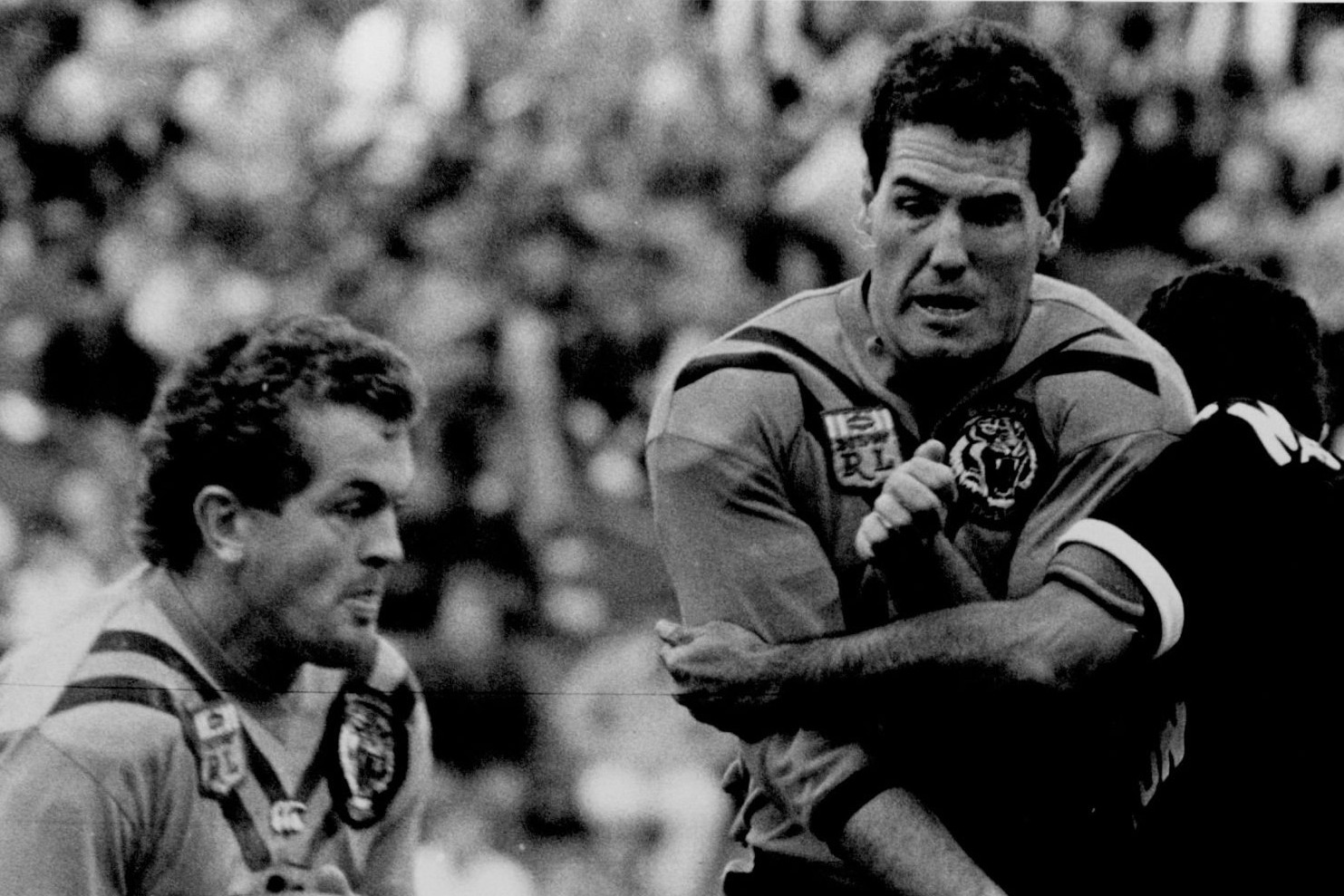
Penrith justified every frustrating year Clarke spent trying to escape reserve grade. He arrived in 1990, played more than 20 matches and became a regular first-grader, although the club’s preparation could occasionally resemble a bucks party with football attached.
Four days before the 1990 grand final, eight players put away three cartons and ordered champagne, then hid under beds when Phil Gould arrived. Clarke had consumed two middies elsewhere to settle his nerves and found the whole episode extraordinary; the others, he reckons, behaved like that almost weekly. Gould made them train lightly to sweat it out, but Canberra’s experience prevailed in a match Clarke remains convinced Penrith could have won.
A year later they finished the job. Clarke’s first half was awful — a dropped ball, missed tackles and poor yardage — before he recovered strongly, prompting Royce Simmons to crown him man of the match because he had been Canberra’s best player before becoming one of Penrith’s best. The premiership meant more than a ring: rain fell during the civic celebration, children beamed, and a district once dismissed as Westies and losers finally had something entirely its own.
Ben’s death changed everything
The hardest part of Clarke’s story is where the laughter stops. Penrith had dreamed of building an era after its first premiership, but inconsistency arrived before Ben Alexander’s death knocked the wind from a team whose closest relationships ran straight through its best players.
Alexander’s brother was Penrith’s leading player, MG was his brother-in-law and Freddy his best mate. Clarke remembers Gould delivering something like a war speech, telling grieving players it would be understandable to give up but asking them to finish the season so nobody could question their effort.
They did not collapse or suffer regular floggings; they kept working, but Clarke says their attack disappeared and the club carried the damage for years. A brutal, narrow loss to Brisbane eventually ended their finals hopes, with Clarke requiring stitches around his eye after one of the toughest matches he played.
There is no punchline here, nor should there be. Of all his memories — the drinking, dressing-room pranks and grand-final noise — this is the one that exposes how quickly a football family can be overwhelmed by something football cannot fix.
The salesman was always hiding inside the prop
Clarke’s Parramatta years prove he was built for life after football, even if the handover occasionally happened while he was still playing. He joined on the best money of his career, scored three tries and worked in sponsorship with Steve Edge, hosting lunches, cruises and functions while Parramatta struggled near the bottom.
Edge told him to keep sponsors happy, and Clarke interpreted that literally. He arrived at Friday training drunk more than once after entertaining clients before a Sunday match, explaining to Peter McPhail that it was work for Parramatta rather than pleasure. It sounds outrageous now, but Clarke believes Edge’s relationship-building helped prevent sponsors from abandoning a struggling club.
His retirement became another classic Nobby mishap. When I needed perhaps 30 lines for a small Daily Telegraph item, Clarke offered up his retirement, the story ran and Super League ruled him out because he had already announced he was finished. He admits his body was gone and another pre-season was impossible, although he reckons he could have bluffed through the odd match.
Wine sales became the natural second act. Clarke freely admits he is no sommelier, but football recognition opened doors and conversation did the rest. After six companies, he remains loyal to his wallet, plans to reduce his workload in two years and knows full retirement would involve far too many lunches. That self-awareness, like his sales pitch, has served him beautifully.