Tarryn Aiken carried heartbreak onto the field & became the best player in the world
The little girl who refused to miss out
Aiken was always going to find her way onto a rugby league field, even when the game itself gave girls precious little room to stay there. Born in Gosford, raised first on the Central Coast and then in Tweed, she recalls being about five when she tagged along to her brother’s registration day at Wyong and asked to play.
Her mother initially said no, her father gave the green light and, once permission was secured, Aiken never looked back: “I don't think they thought I'd last long, but yeah, ended up playing my whole juniors.”
The shame is that the pathway abandoned her after under-12s. Girls-only competitions did not exist locally, while many women’s competitions would not accept players until they were 18, leaving a six-year hole where football should have been. Aiken filled it with touch, alongside soccer, nippers and netball, and she believes those touch pathways made her eventual return much easier. The game nearly lost her; instead, all those other sports helped shape the footballer it now celebrates.
From backup utility to premiership player
Aiken’s rise is a reminder that careers are often built from gratitude before they are decorated by greatness. When the Sea Eagles formed their first women’s team in 2019, she joined immediately, entered the system and soon found herself in the second NRLW season, apparently signed as cover across the park rather than as a guaranteed starter.
She debuted in round one, kept her place as a bench utility and reached the grand final, never quite knowing until late in the week whether she would play.
By 2020, Aiken felt she had a more established position, although the COVID season brought its own strange rhythm: chartered flights, a same-night return to Brisbane after winning the premiership and celebrations confined to the club. She later left that comfort zone for the Roosters, drawn by Ethan Strange’s vision for her game and by a club where everyone made her feel welcome. That leap mattered because comfort might have kept her good; leaving it helped make her exceptional.
Her greatest strength was surviving the unimaginable
No medal explains Aiken better than the way she kept moving after her world collapsed. Soon after her 2019 premiership, her father died, followed shortly afterwards by her brother, taking what should have been one of the happiest periods of her life and turning it inside out.
I cannot think of a rugby league cliché big enough to hold that sentence.
Her father and brother had been woven through her football life: front-yard games after school, trips to training and local A-grade matches, teasing over her playing for Brisbane, and the promise from her brother that he would fly down for every game after her debut. Football became an outlet, while teammates, friends and her close-knit family, especially her younger brother and sister, helped her through.
She now tries to take her father and brother onto the field with her during the biggest moments. I reckon that is why her triumphs carry such depth: every trophy is also an act of remembrance.
The Golden Boot belongs in Tweed
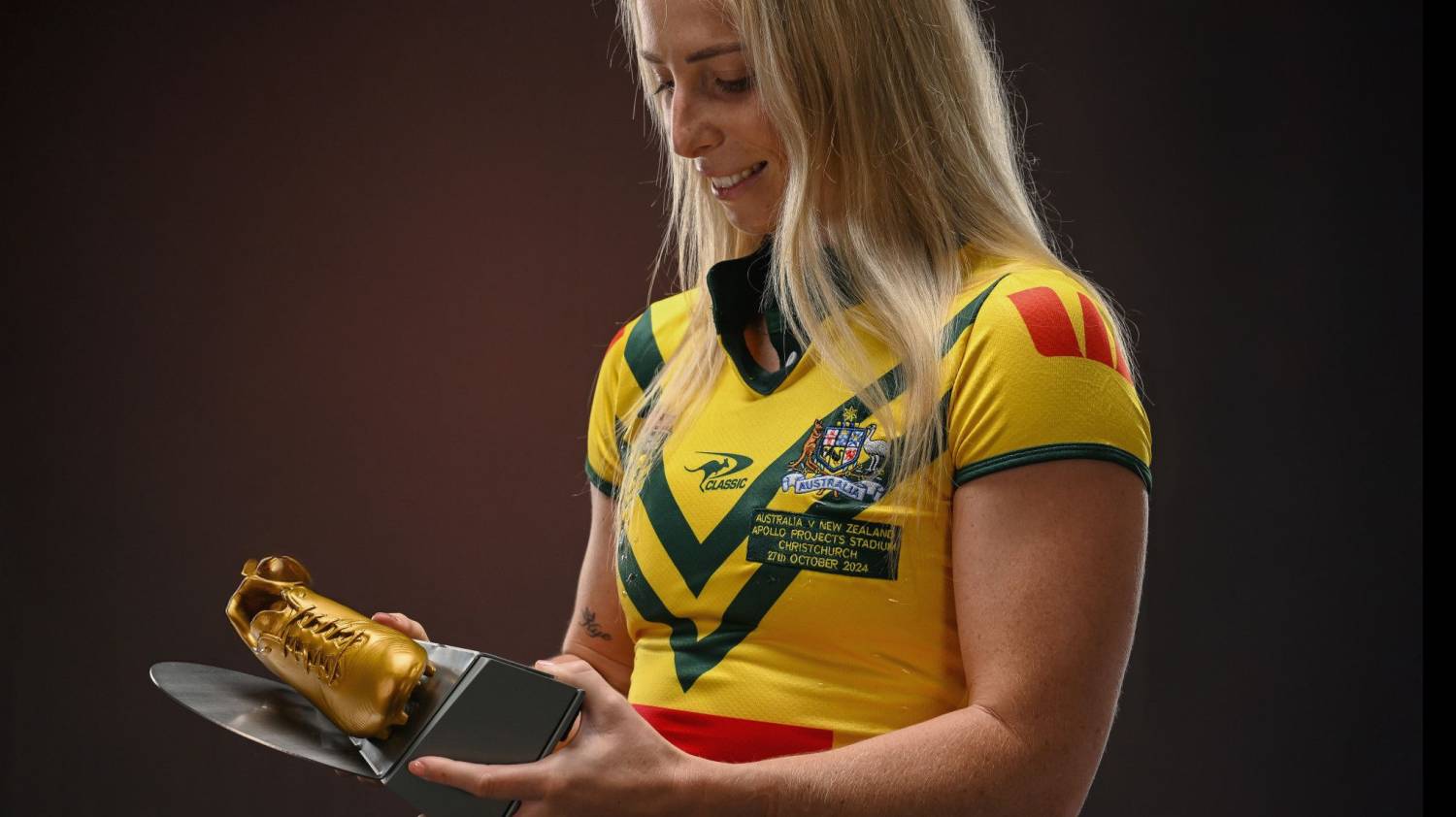
The Golden Boot confirmed what Aiken’s performances had already made plain: she had reached the summit of the international game. Following an outstanding representative season and Pacific Championships campaign, she received the award chosen by an independent international group judging representative fixtures.
Aiken was genuinely surprised, believing Tamika and Shenna-Marta had also produced unreal seasons, and the achievement took time to sink in after a surreal presentation day. “That was really humbling and yeah, it was great to receive the award,” she says.
The trophy itself is large, heavy and sculpted like a boot, but the best detail is where it lives: back at the family home in Tweed with her mother. That feels exactly right. The journey began with family, survived devastating family loss and now places the game’s highest individual honour back where the story was made.
It capped a remarkable run that also included the 2024 premiership with the Roosters, State of Origin success and the Karen Murphy Medal for her grand-final performance. Aiken may speak softly about all of it, but the record roars.
Vegas proved the women belong on the biggest stage
I believe women’s rugby league must remain part of the Vegas venture because Aiken’s experience proved the appetite is already there. Fremont Street was packed, supporters recognised the players as they walked around and many people had travelled specifically for the games. The women had never experienced a reception like it.
The result was heavily lopsided and nobody in the team expected it, so I accept the format needs revising, perhaps through a Kiwis match, State of Origin or an NRLW fixture. But retreating would be cowardly. I have no doubt the women need to be there.
The trip also exposed the human pressure surrounding elite selection. Many players were shocked when Olivia, the Dally M winner and incumbent backrower, missed the Pacific Championships, but I was more disappointed by outsiders questioning her character. I regard her as an outstanding teammate, and the way she handled the scrutiny before returning for Vegas showed precisely who she was. Selection can be debated; character should not be casually dragged through it.
Professionalism must come before reckless expansion
Aiken is dead right to prioritise full-time professionalism over simply adding more teams. She expects every NRL club will eventually field a women’s side, but existing players first need the resources, squad depth and preparation standards required to make the competition stronger rather than merely larger.
Current squads have 24 players, and Aiken recalls the Roosters once struggling to name 17 last season; with the campaign growing longer, bigger squads are essential. The emerging generation is ready, she calls the Roosters’ Lisa Fiola players “guns” and says 17-year-olds who have played continuously possess freakish skills, but the competition cannot keep asking elite athletes to survive half-built systems.
Scheduling also needs common sense. Matches at 11am on Saturdays collide with children’s sport, so poor crowds at those times say more about the fixture than the product. Better slots and a longer season will allow supporters to follow teams properly.
The next CBA should make full-time status the priority, potentially from 2028. Equal pay remains the distant goal; a genuine profession is the urgent one.
She learned to control games without losing the joy
Aiken’s development from instinctive five-eighth into elite halfback shows why great coaching is about adding understanding without smothering talent. She arrived at the Roosters admitting she had no idea how to manage a game, having previously preferred simply playing whatever appeared in front of her.
Ethan Strange taught her to understand her role and those around her, gave her an NRL match to study each week and directed her attention towards Nathan Cleary and Jahrome Hughes. Cooper Cronk then offered detailed lessons without making the game unnecessarily complicated, a pinch-me experience for somebody who had admired him growing up.
That education now meets a delicious Origin complication, with John Strange appointed to coach New South Wales against her. Aiken encouraged him to accept the opportunity and expects the Blues to learn plenty, although she concedes it makes Queensland’s task harder.
Origin remains the pinnacle for her: physical, skilful and played among the best. Yet her immediate ambition is wonderfully simple, keep winning trophies, because, after everything, Aiken still says she is “really living the dream.”