The Roosters are through because their biggest gambles finally make sense
The Roosters built for this moment
The Roosters’ 36-20 victory was not a smash-and-grab job; it was a high-quality preliminary final won by the side with greater control, sharper execution and more ways to break the game open. Beating the Dolphins at Suncorp Stadium before 52,000 Queenslanders was a serious performance, particularly when both teams completed highly and treated possession with respect.
The decision to buy Daly Cherry-Evans has been vindicated because his presence allowed Sammy Walker to wait for the game rather than wrestle it into submission. Walker earned repeat sets with his kicking, spotted Finau Fuimaono fall in the defensive line and scored, while Cherry-Evans provided the experienced hand beside him after those botched field-goal attempts contributed to the loss against Penrith in week one.
The concern is Walker’s left leg. He appeared ginger after scoring, left with 13 minutes remaining and had ice behind his knee, which makes his fitness the defining story of grand-final week. He may have felt only a minor twinge and the nine-day turnaround matters. It will be touch and go all week, but I’m sure he will play.
The bunker failed the Blind Freddy test
Jamayne Isaako’s try should never have survived review. This was not a microscopic frame, an obstructed angle or one of those calls where reasonable people can reach different conclusions; the replay showing the full ball clearly had it grounded on the sideline.
Adam Gee awarded the try on the field and Ashley Klein confirmed it from the bunker, despite Klein already being under pressure after the controversial non-penalty at full-time in the previous weekend’s game won by Newcastle. Refereeing is brutal work and the bunker offers nowhere to hide, but sympathy cannot become an excuse. A stuff-up remains a stuff-up.
Marky Mark’s wild pass was different because his foot only looked as though it might have touched the sideline. That one allowed room for interpretation. Isaako’s grounding did not, and repeated mistakes on the biggest stage drag attention away from the footballers who deserve it.
Victor Radley, meanwhile, should have nothing to fear over his tackle on Izzy Katoa. Katoa had penetrated the line and momentum put Radley into an awkward position; it was not the classic hip-drop action, and I expect the NRL to view it as an accident.
Marky Mark owns the big stage
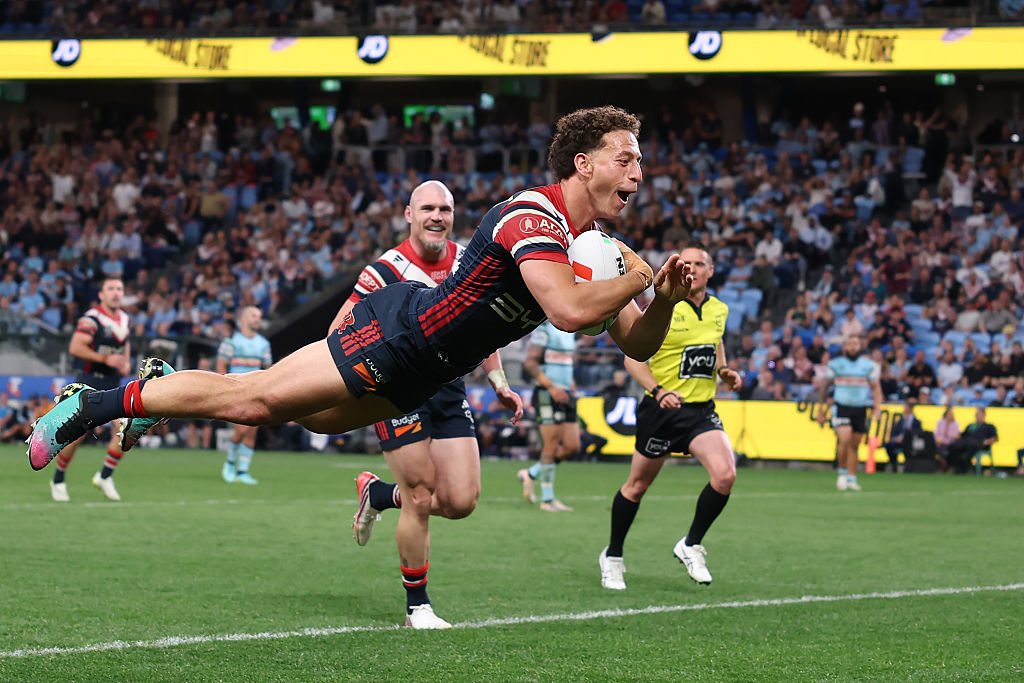
The question hanging over Marky Mark was never talent. It was whether the diamonds would still outweigh the stones when a season was on the line. We got the answer at Suncorp Stadium: emphatically, yes.
His first major intervention changed the game. Herbie Farnworth was poised to put Selwyn Cobbo away, only for Marky Mark to shoot out a hand, steal the pass and race 90 metres to score. Later, when a play appeared exhausted, he stayed alive long enough to flick the ball inside for another try. He finished with two tries and 313 metres, almost double the next-best tally on the field.
The athleticism is obvious, but that is not what separates him. Plenty of wingers are fast, powerful and spectacular. Marky Mark has time. He can goose-step, kick, flick a pass or overpower defenders, and opposition players hesitate because every option remains available to him. The impossible looks routine; the routine occasionally looks like performance art.
I had wondered whether his risk-taking could become a liability under finals pressure. Instead, the bigger the occasion, the clearer he seems to think. Marky Mark did not merely dominate a preliminary final. He owned it — and now he gets the stage made for him.
Robson has become the complete No.9
Reece Robson is no longer merely an industrious dummy-half who tackles all night and occasionally steals metres; he has developed the deception and craft required to manipulate the best defensive lines.
His work for Radley’s try captured that growth. Robson played square, kept the A and B defenders honest, recognised the opening and delivered the pass, adding attacking polish to an engine already capable of producing 80 quality minutes. Origin has undoubtedly lifted his confidence, and the Roosters have clearly invested considerable time in expanding his game.
That durability becomes even more valuable because Connor Watson was ruled a Category One HIA, triggering a mandatory 11-day stand-down when the grand final was only nine days away. The ruling was initially Category Two before being upgraded, and the Roosters will undoubtedly mount a medical case to have Watson cleared. How that campaign ends is genuinely unclear, but it will dominate the week.
If Watson cannot play, Robson’s ability to stay on the field removes one problem immediately. Grand finals expose roster weaknesses; the Roosters have built theirs so one setback does not become a collapse.
The Dolphins’ attack hid a fatal flaw
The Dolphins deserve enormous praise for an elite season, but their defensive habits were always going to collect them eventually. A top-four finish, eight consecutive wins and a home preliminary final in only their fourth year exceeded virtually every expectation, yet finals football is an audit and the Roosters found the missing receipts.
The tries conceded to Lindsay Collins and Radley were unacceptable in a regular-season match, never mind a preliminary final. Naufahu Whyte powered through the middle early, the Roosters seized control and, although the Dolphins reduced the deficit, they never produced their best football with or without the ball. Jack Bostock created late-play opportunities and Herbie Farnworth was outstanding with what he received, but isolated brilliance could not repair the defensive leaks.
A high-scoring style can carry a side through the regular rounds; against hardened teams such as the Roosters and Penrith, inconsistency without the ball sends you home. That must drive the review.
There is still ample cause for optimism. Kodi Nikorima will join St George Illawarra next season, while George Williams’ move to the Dolphins was completed as early as January despite still not being officially announced. He will enter the halves, but the next step will be decided by defence, not another attacking ornament.
Penrith’s middle will decide Newcastle’s fate
Newcastle have the class to trouble Penrith, but I expect the Panthers’ middle to decide the second grand-final berth. Justin Holbrook has unified the Knights and Peter O’Sullivan deserves enormous credit for the roster, yet travelling to Accor Stadium without Dylan Brown, Jacob Saifiti and Trey Mooney strips away too much power and control.
Kalyn Ponga, Fletcher Sharpe and Bradman Best can fracture any defensive system because big matches are sometimes won by the players capable of producing what a game plan cannot. The Knights also look happy and connected, which matters after repeatedly being dealt difficult circumstances this year.
But Penrith remain a juggernaut who have appeared in pretty much every grand final across the past five years, with Nathan Cleary and Isaah Yeo among the competition’s finest players. If their forwards control the middle against an inexperienced Cody Hopwood and a bench containing Lachlan Crouch, Newcastle’s strike will spend too much time attacking from poor field position.
Liam Martin will be wound up like a Husqvarna chainsaw on the right edge. Newcastle will make this uncomfortable, but Penrith’s experience and middle-third authority should carry them through.